Press Freedom, Professional Ethics and Safety of Women Journalists Vital to Democracy: Justice G. Radha Rani
- No Woman Should Be Silenced Out of Fear: Minister Seethakka
- Women Journalists Must Embrace Leadership and Fearlessness in a Democracy: Sumathi, IPS
- Two day National Seminar of women Journalists inaugurated
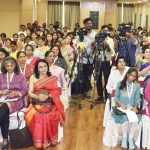
- Women Journalists across the country attended the seminar
Justice G. Radha Rani, Hon’ble High Court Judge (Retd.) and President of the Telangana Consumer Disputes Redressal Commission, in her keynote address, highlighted the vital role of women journalists in strengthening democracy, upholding press freedom and bringing the concerns of marginalised communities to the forefront.
She said a national conference provided an opportunity to reflect on the challenges faced by women journalists and discuss ways to ensure their safety, professional independence and equal opportunities. She stressed that democracy could not survive without a free press and acknowledged the significant contribution of women to journalism.
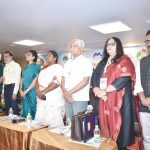
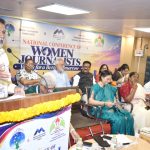
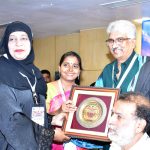
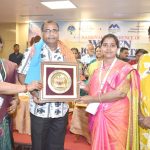
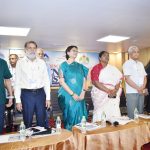
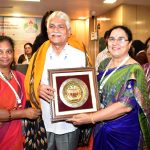
Two days National Conference of Women Journalists organised by Indian Journalists Union (IJU), Media Education Foundation INDIA (MEFI), Telangana State Union of working Journalists (TUWJ) was inaugurated on Saturday at Hotel Tourism Plaza in Hyderabad. Women Journalists from different states attended the National Conference.
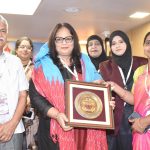
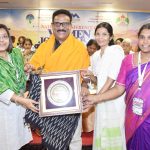
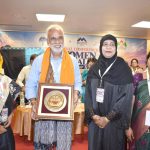
Minister for Panchayatraj Seethakka, High court (Retd) Justice K.Radha Rani, Malkajgiri Police Commissioner Sumathi, Telangana Media Academy Chairman K.Sreenivas Reddy, Karnataka Media Academy Chairperson Ayesha Khanum, IJU steering Committee members D.Amar, S.N.Sinha, President Balwinder Singh Jammu, Secretary General D.Somasundhar, TUWJ state President K.Virahath Ali, General, Secretary K.Ramnarayana Graced the occasion. Inaugural session conducted by Senior Journalist Swapna, TUWJ women’s wing convenor Rajeswari Kalyanam, Senior Journalist Aruna.
Emphasising the importance of credible information, while delivering keynote address, Justice G..Radharani said journalists must ask uncomfortable questions and faithfully report facts. Freedom of the press, she noted, was also the citizens’ right to know the truth. Recalling the struggles of earlier generations of women journalists, she said they had to overcome prejudice and challenge barriers through their competence. Today, women were leading the field, enriching journalism by bringing attention to child rights, the economic struggles of women, gender stereotypes and other important social issues.
She cited journalists such as Dhanya Rajendran, Neha Dixit, Grishma and Meera Devi, who, working across different platforms and settings, had demonstrated what women could achieve and how journalism could bring about change.
Referring to the constitutional foundations of press freedom, she noted that Article 19(1)(a) of the Constitution guaranteed freedom of speech and expression, with the Supreme Court recognising press freedom as an indispensable part of democracy. At the same time, she said, Article 19(2) provided for reasonable restrictions. Journalists must therefore act responsibly, respect individuals’ privacy, follow professional ethics and refrain from intimidating people.
She observed that digital platforms had created new avenues for women to express themselves, but had also exposed them to new forms of intimidation. She called upon media organisations to address workplace harassment and implement the Prevention of Sexual Harassment (POSH) Act in both letter and spirit. She stressed the need to build a culture in which complaints of harassment were taken seriously and addressed fairly.
Highlighting the challenges posed by digital journalism, she said the spread of misinformation, deepfakes and AI-generated fabrications had made fact-checking more important than ever. Credibility, she emphasised, was journalism’s most valuable asset in the digital age. She underlined the role of women journalists in bringing the experiences of socially and economically disadvantaged communities and individuals to public attention, thereby helping drive institutional reforms. She stressed that fair investigations and the protection of individual rights were essential. A journalist’s responsibility was not to pre-screen information to suit particular interests, but to present and verify facts, even when they were inconvenient.
She also called for professional support for journalists working in vulnerable and high-risk areas and urged media organisations to address the threats they faced. Questioning those in power, she asserted, should not be equated with sedition. A mature democracy must make room for dissent. Emphasising the need to ensure safety, equal opportunities, fair institutional remedies, respect, solidarity, professional independence and recognition of competence, she called upon media organisations to uphold these fundamental values and create a supportive working environment for women journalists. She concluded by stressing that journalists must use their reporting to uphold justice, dignity and hope for ordinary citizens. “The success of a woman journalist is a measure of a mature society. Let us build a society that respects and listens to the voice of every woman journalist,” she said.
No Woman Should Be Silenced Out of Fear: Minister Seethakka
Danasari Anasuya (Seethakka), Hon’ble Minister for Panchayat Raj & Rural Development, Women & Child Welfare, stressed that every woman has the right to question, disagree and live with dignity. She raised concerns over the safety and professional rights of women journalists, emphasising that no woman should face intimidation or retaliation for doing her job.“Can a woman journalist perform her duty without fear?” she asked, describing reports of assaults and sexual harassment of women during the protests against CEC Gyanesh Kumar as deeply disturbing. She also called for careful and impartial examination of the subsequent developments, including cases filed against women journalists who raised complaints.
“Why should a woman journalist face intimidation, retaliation, character assassination or misuse of the law for doing her job? A woman holding a microphone is not an enemy, and a journalist asking uncomfortable questions is not a threat. The real strength of democracy lies not in preventing questions, but in having the courage to answer them,” she said. Referring to patriarchal traditions, including interpretations of the Manusmriti, she highlighted their historical role in the oppression of women and asserted that the Constitution of India was supreme. She recalled Dr B.R. Ambedkar’s understanding that political democracy could not survive without social democracy. Quoting him, she said, “I measure the progress of a community by the degree of progress which women have achieved.”
She said these words reminded society that true progress was impossible as long as women remained unequal or unheard. The Constitution recognised women as equal citizens, not as subordinates to their fathers, husbands or sons. “We are not asking for charity, but for the rights guaranteed to us by the Constitution,” she asserted. Emphasising the role of the media as the Fourth Pillar of democracy, she said elections alone did not make a democracy. Accountability, informed debate and the freedom to question those in power were equally essential. Recalling Mahatma Gandhi’s ideals, she stressed that journalism must pursue the truth and stand by it.
Drawing from her experience as the Minister for Panchayat Raj, she spoke about the strength of women at the grassroots level and highlighted the connection between economic independence, education and political participation. She said a woman could not be truly empowered if she had economic opportunities but was denied her voice. Similarly, a woman journalist could not be professionally independent if she had access to a newsroom but lived in fear of intimidation outside it.
She called upon the Indian Journalists Union (IJU) to give greater attention to the safety, dignity and professional rights of women journalists. She also urged women journalists to stand united, irrespective of their ideologies and associations, especially when their rights were under threat. “Let us build a society where no woman is silenced out of fear,” she said.
Women Journalists Must Claim Their Space in Newsrooms: Ayesha Khanum
Ayesha Khanum, Chairperson of the Karnataka Media Academy, recalled her days covering the Telangana separate statehood movement and emphasised the need for women journalists to claim their space in newsrooms and become proactive defenders of rights. “Women are united by empathy, and that makes us different. We are often branded as gossipmongers when we are seen talking, but communication is also how we connect with one another. Let us turn this negativity into positivity by filling the gap in the media with our stories of empathy,” she said, adding that there was ample scope for women journalists in the media today.
She stressed that leadership and competence had no gender. “If leadership and competence have no gender, why are women pushed away from these spaces?” she asked. She said leadership required vision, integrity and the way one conducted oneself.
Highlighting the Karnataka Media Academy’s efforts to help women journalists adapt to technological advancements, she said the Academy had partnered with Infosys to train women journalists in artificial intelligence (AI) and help them upgrade their technological skills.
She observed that women were becoming less assertive and allowing themselves to be provoked less often, and stressed that they should not hold back from expressing their views. She called upon women journalists to question authority and claim their rightful space in newsrooms, noting that journalists had earlier shown greater courage in questioning those in power, but the situation had changed over time.
Emphasising the importance of preparation and professional ethics, she urged women journalists to enter the field with adequate knowledge and a strong understanding of journalistic principles. Calling upon them to become proactive defenders of rights, she quoted Russian-American author Ayn Rand: “The question isn’t who is going to let me, it’s going to stop me.”
Women Journalists Must Embrace Leadership and Fearlessness in a Democracy: Sumathi, IPS
Sumathi, IPS, Commissioner of Police, Malkajgiri Commissionerate, emphasised the importance of democracy, leadership and professionalism in journalism, calling upon women journalists to take up leadership roles and report fearlessly while respecting diverse opinions.
“As an enforcer of the law, I present myself before the Fourth Pillar. We women look at every issue from a 360-degree perspective. Understanding and reporting these issues is not an easy job,” she said.
Recalling an incident from 2003, when she was the Superintendent of Police in Warangal, she spoke about witnessing the Leader of the Opposition leading a huge rally across undivided Andhra Pradesh. A woman journalist told her that the tables had turned and a change in governance was imminent. The journalist’s report analysed the reasons behind her assessment, earning Sumathi’s admiration for the profession.
Referring to the digital era, she said there was immense scope for journalists to express themselves. She stressed the need to focus on democracy, leadership and professionalism, particularly in the world’s largest democracy, where the responsibility to influence and guide the younger generation was significant.
Referring to recent national protests, she observed that the country was facing challenges that questioned the state of democracy. She pointed out that women often had to prove themselves to gain entry into public spaces, including politics, the judiciary, bureaucracy and the media.
She also noted the growing number of women choosing themselves over marriage, suggesting that this reflected their aspirations for leadership within a democratic framework. With Gen Z emerging as an important component of India’s future and the South becoming increasingly intellectual, she raised questions about the kind of leadership society needs and how people can communicate these expectations to those in power.
In this context, she said women journalists were demonstrating their ability to lead fearlessly while acknowledging the views of other women. She also highlighted how women journalists had approached the police with complaints related to workplace issues and patriarchal challenges, despite their professional competence.
Emphasising the need for greater representation in the field, she called upon women journalists to become the faces of journalism by engaging more actively in reporting rather than limiting themselves to editing.
“As women, we know that this journey has not been easy. It is a fight with others and with ourselves. We need to overcome several challenges along the way,” she said, urging women to draw inspiration from politicians, intellectuals and people in positions of power.
IJU President Balwinder Singh Jammu opened the conference by recounting incidents of women journalists being harassed and subjected to sexual violence by the police during the SIR protests in Delhi and Mumbai.
He also recalled the contributions of fearless women journalists like Ritika Chopra, who exposed serious gaps in the functioning of the Election Commission of India and reported on the deletion of votes during the Special Intensive Revision (SIR) of electoral rolls.